‘The number of [female] trainees that have passed through these colleges has added considerably to our fighting and production forces throughout the country and without them we should have been seriously handicapped.’
- The Right Hon. Ernest Bevin M.P., Message to the College, 1941.
The previous article provided a general overview of education and life at the College during the war years. This article narrows the focus to women at the College who were considered civilians, i.e., not part of the military branches, such as the Auxiliary Territorial Service (ATS), Women’s Auxiliary Airforce (WAAF) and Women’s Royal Naval Service (WRNS) who occupied the College during the same period. Instead, civilian women worked in factories, ran campaigns like Make Do and Mend and supported communities with medical care and childcare.
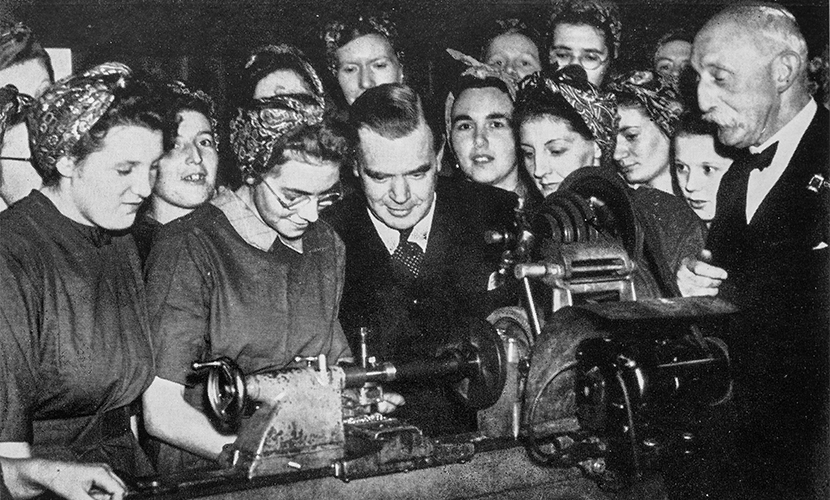
Female students were heavily involved in aiding the war effort through their classes and by organising and participating in various groups and organisations. In the period 1940-1944 there was a heavy reliance on women working in factories producing a vast range of equipment and munitions for all branches of the British Armed Forces and allies. The task of training these women fell on technical colleges across the country and the South-West Essex Technical College was no exception. During this period about 700 women were trained in aspects of engineering such as fitting, turning, welding, milling, capstan operation and more. These courses ‘attracted a great deal of attention, and both the local and the national press carried articles and photographs of the women at work.’[1]
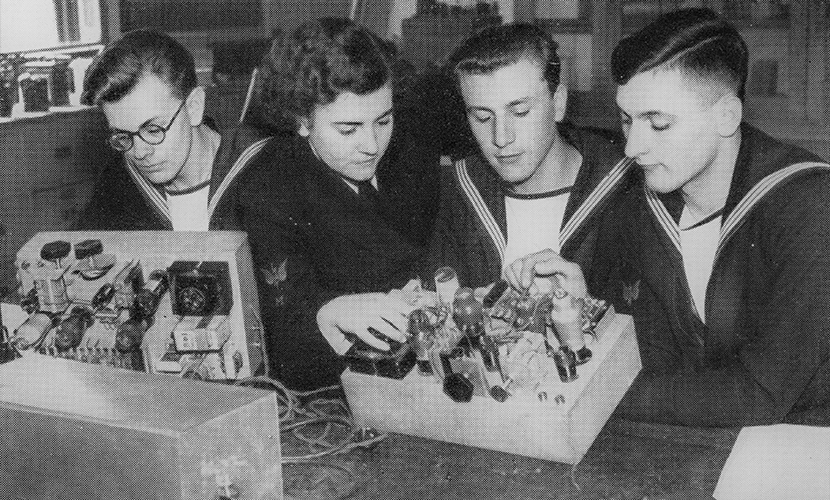
On occasion, women were also introduced to some courses alongside men. In the 1942-1943 period the Science Department provided classes to train laboratory assistants for the Ministry of Supply Research Laboratories. Small groups of ten to fifteen students were selected from secondary schools and taught subjects including basic physics, magnetism, electricity and elements of radio. In all, about twelve of these groups were trained.[1] This wasn’t especially new to the College as women had been invited to study alongside men in various courses as indicated in the brochure of the Official Opening, ‘It may be noted here that all courses are open equally to women and to men.’[2]
Women who chose not to enter or were not selected for science or engineering roles were often placed under the umbrella of Mrs L. A. Brazier, Head of the Domestic Science Department. In this department the focus was more on the domestic side of the Home Front and was kept extremely busy with work inside and outside of the many campus and satellite buildings of the College.
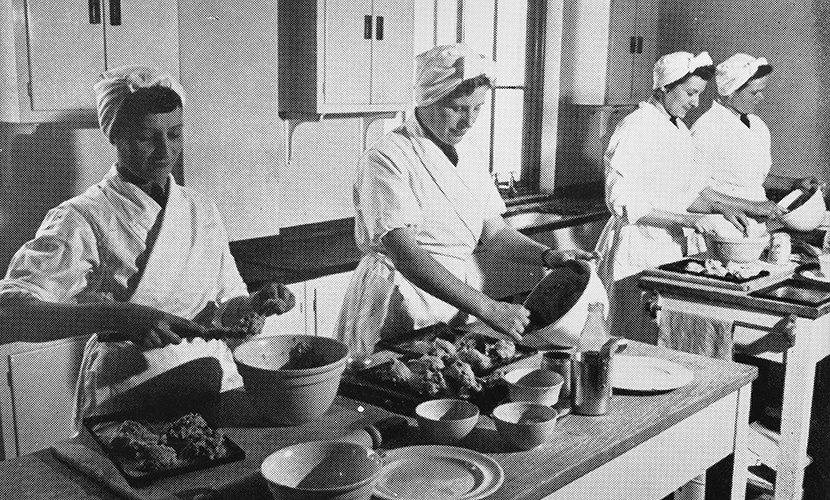
In October 1941 the Domestic Science Department started a course for Nursery Nurses as part of the Child Care Reserve. The Child Care Reserve was a scheme developed by Minister of Labour and National Service, Ernest Bevin M.P., to provide nurseries in munition factories so the children of munition workers could be cared for while their parents were at work. The Child Care Reserve was established to be called upon in the event of widespread air raid damage and to operate in nurseries connected with munitions factories.[3] Students from the College received a Nursery Nurses Diploma from the National Society of Children’s Nurseries. The women of the Child Care Reserve were an essential part of the Home Front, allowing many married women who had children to work in the factories.[1]
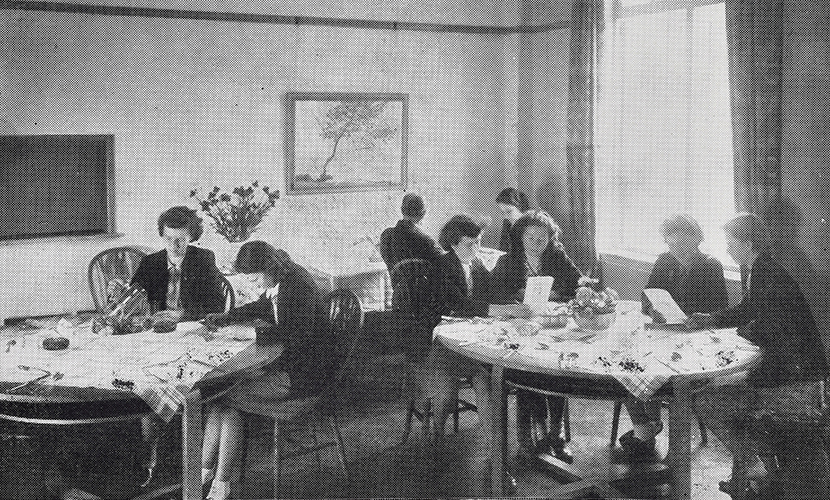
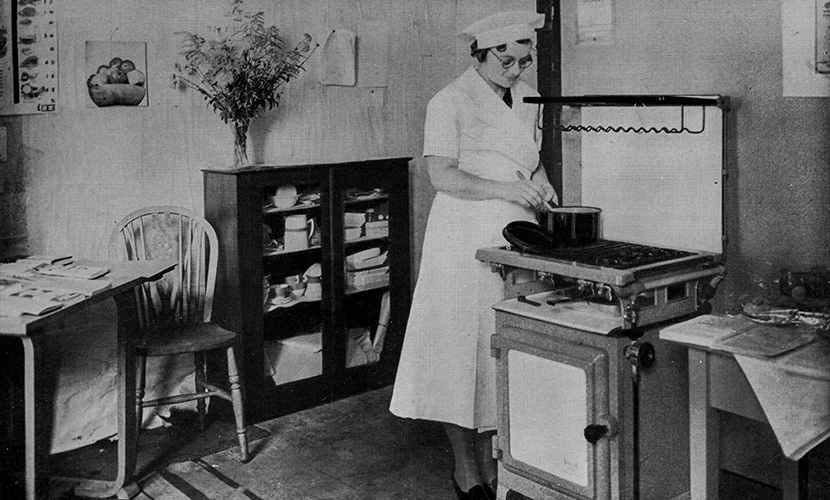
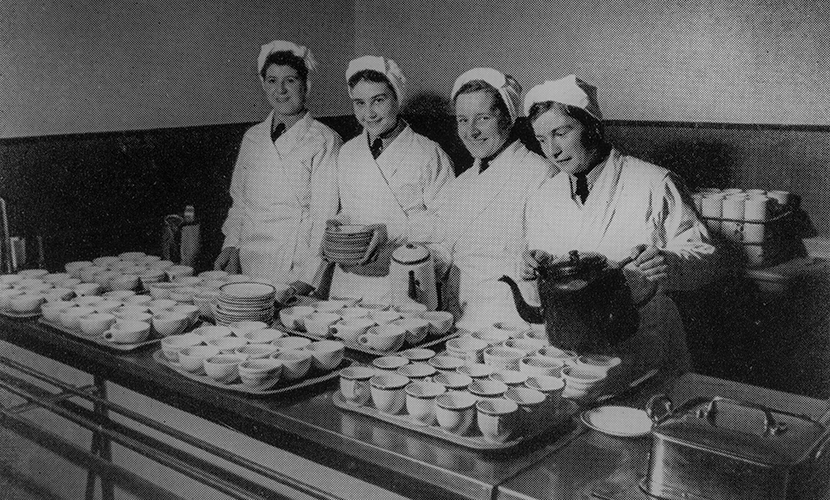
The students of the Women’s Voluntary Service (WVS) were taught several specially designed courses. One such class was Emergency Field Kitchen in which WVS members would learn how to cook in situations where houses had been bombed and no gas supply was present. In total, about 100 women attended this course at the College. There was also a handywoman’s course in which the WVS were taught the maintenance and repair of furniture, household equipment, plumbing and electrics. This course turned out to be quite popular.[1]
The National Food Campaign was aided by the Domestic Science Department by providing lectures and demonstrations to women’s organisations and talks to canteen staff in workplaces. During the 1939-1942 period these lectures and demonstrations started with how to make the best use of rationed and non-rationed food, but in 1943 the Board of Education asked the College to ‘extend our extra-mural activities so as to include Make-Do and Mend.’[4] Make Do and Mend was part of the Government’s campaign during the June 1941-1949 clothes rationing period to encourage people to repair, reuse and reimagine their existing clothes.[5]
The main local base of Make Do and Mend was the College, and initially almost all the classes were delivered from College grounds. However, it was soon realised that some of the villages in the region were too far away from the College for easy attendance and were too small to house a demonstration shop. In one of the many departmental collaborations at the College, the automobile section of the Engineering Department sourced and overhauled an Austin Six, while the Department of Architecture and Building designed a special body to produce a demonstration van enabling people in more remote parts of the region to access Make Do and Mend classes.[4]
‘[The] body [of the Austin Six] had rather the appearance of a caravan, and contained cupboards, oil stoves and so on. The specially ingenious features were that the sides let down and formed windows in which was a display of Make-do and Mend goods, while the back let down to form a small platform so that demonstrations in cookery could be given to small crowds who would all get a good view, the platform being raised from the ground.’[1]
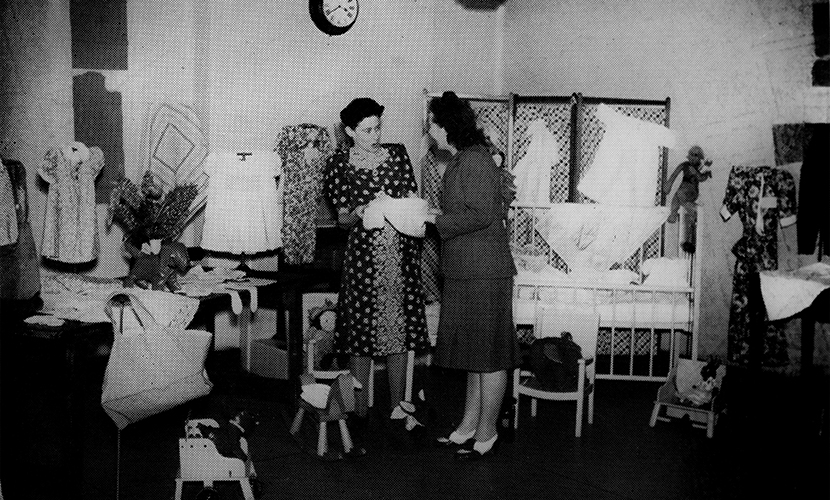
The Austin Six wasn’t the only outreach programme used by the local authority to educate the public. In some cases demonstration and information shops were established in towns. A shop in Hoe Street was open for a year along with other shops that appeared for varying lengths of time in Chingford, Epping and Loughton. ‘Many of the anxious enquirers were men whose wives and families had been evacuated and who were experiencing varied housekeeping difficulties. Their enquiries were wide ranging but perhaps the most amusing was the case of the gentleman who brought along an omelette he had made for criticism.’[1]
Principal Lowery wrote in his 1943 report:
‘I am pleased to report that the new venture in Make-Do and Mend classes was enthusiastically taken up by our own women staff and was well supported by students of all kinds. Old garments were renovated or re-made, children’s toys were produced from materials that would otherwise have been regarded as scrap, and the foundations of “true domestic economy” were securely laid.’[4]
Principal Lowery also made mention to the College Knitting Party which was established under the leadership and regular attendance of Mrs Lowery. ‘The large quantities of comforts [being created] for the Services and Life-Boat Crews’ at the outset of the party appears to have increased year-on-year with a mention in 1944 of individuals producing up to 50 pairs of sea boot stockings and large numbers of socks. In 1946 Principal Lowery mentions the continuation of the Knitting Party although expresses the difficulty of gaining access to the necessary supplies of wool. Mr W. R. Bray wrote:
‘It is pleasant to record that letters have been received from all parts of the world expressing thanks and appreciation of the work of this group of ladies.’[1]
References
-
W. R. Bray, The Country Should be Grateful - The War-time History of the South-West Essex Technical College and School of Art, London: The Walthamstow Press Ltd, 1947.
-
Essex Education Committee, Opening Ceremony of the South-West Essex Technical College and School of Art, Silver End, Witham, Essex: E. T. Heron & Co. Ltd., 1939.
-
Historic England, “Training the “Child Care Reserve”” No date. [Online]. Available: https://historicengland.org.uk/services-skills/education/educational-images/training-the-child-care-reserve-national-council-for-maternity-and-child-welfare-117-piccadilly-westminster-11915. [Accessed 18 July 2023].
-
H. Lowery, “South-West Essex Technical College and School of Art Annual Report Session 1942-43,” The Guardian Press, London, 1943.
-
Imperial War Museum, “Make Do and Mend, 1943,” No date. [Online]. Available: https://www.iwm.org.uk/history/make-do-and-mend-0. [Accessed 18 July 2023].
-
Imperial War Museum, “How Children’s Lives Changed During the Second World War,” [Online]. Available: https://www.iwm.org.uk/history/how-childrens-lives-changed-during-the-second-world-war. [Accessed 17 07 2023].
-
H. Lowery, “South-West Essex Technical College and School of Art Annual Report Session 1945-46,” The Guardian Press, London, 1946.